


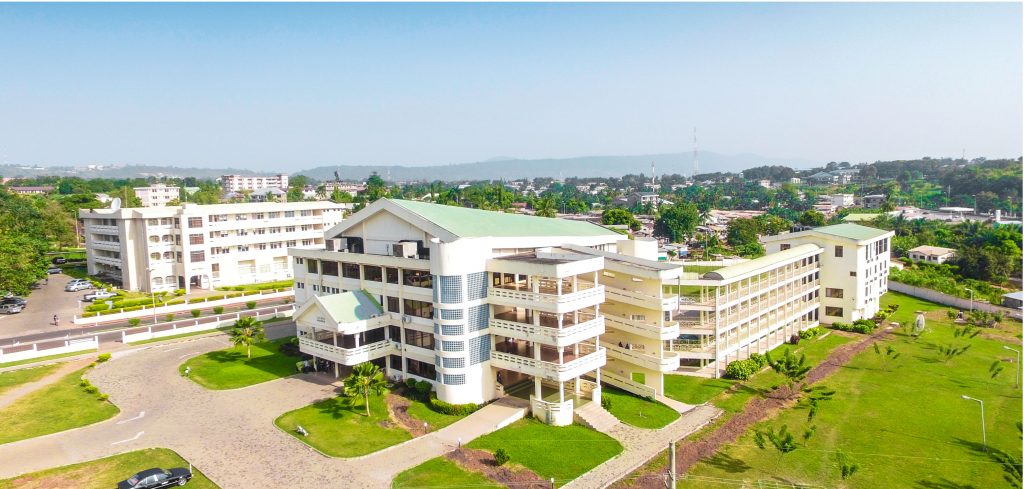


The University on Tuesday, October 27, commissioned a state-of-the-art Communication and Media Technology Laboratory to strengthen practical training and professional development in communication and media production.
In his welcome address, the Dean of the Faculty of Applied Social Sciences, Prof. Deodat Adenutsi, underscored the importance of integrating intellectual inquiry with professional practice in training communication students. He highlighted the laboratory’s potential to promote applied research, student enterprise and partnerships with media organisations, industry, public institutions and communities. He urged faculty members and partners to foster a culture of mentorship, collaboration and responsible management to ensure the facility delivers lasting value to the University and society.

The Vice-Chancellor, Prof. Ben Q. Honyenuga, described the laboratory as a strategic investment in the University’s commitment to career-focused education and graduate employability. He recalled that when the University admitted its first cohort of students into the BA Communication and Applied Media Technology programme in the 2024/2025 academic year, practical training initially took place at the University’s radio station, VP FM. He noted that the new facility would provide students with the environment to develop professional competence and confidence, preparing them to secure employment, create opportunities for themselves and contribute to Ghana’s creative and digital economy.
Prof. Honyenuga charged the relevant academic departments and technical and administrative teams to ensure the laboratory’s effective management, maintenance and optimal utilisation. He stressed that its success would ultimately be measured by the quality of graduates it produces, the innovations it inspires and the opportunities it creates.

Delivering the keynote address, the Executive Secretary of the National Media Commission (NMC), Mr. George Sarpong, challenged students to use the facility to tell stories that highlight the Volta Region’s cultural heritage and address pressing national issues. He encouraged them to explore local traditions through documentaries, digital archives, photography and film, noting that such productions could preserve indigenous knowledge while creating career opportunities.
Mr. Sarpong also called on communication students to collaborate with colleagues from other disciplines to make specialised knowledge accessible to the public. Emphasising the importance of professional ethics, he urged them to verify information before publication, distinguish facts from speculation and respect the people whose stories they tell. He cautioned against sacrificing accuracy for attention, stressing that responsible journalism was essential in combating misinformation and disinformation. He further pledged the NMC’s support for the Department and the University at large.
The Head of the Department of Applied Modern Languages and Communication, Dr. Harrison Adjimah, highlighted the need for HTU to respond to the changing media landscape driven by advances in digital technology. He noted that the laboratory reflected Management’s commitment to providing the infrastructure needed to bridge the gap between theoretical knowledge and practical application.

The ceremony also featured the inauguration of the Ghana Journalists Association (GJA) HTU Student Chapter, during which Communication and Applied Media Technology students were sworn into the association by Mr. George Sarpong, and the Volta Regional Chairman of the GJA, Dr. Harrison Kofi Belley.
The Communication and Media Technology Laboratory is equipped with modern audiovisual recording equipment, including a dedicated television studio for newscasting, interviews and live programmes, and a podcasting section for high-quality audio recording. Other facilities include professional cameras, lighting systems, microphones, sound mixers, editing suites, drones for aerial cinematography, field recording devices for outside broadcasts, a 10-input video mixer for live production and streaming, and an interactive screen to enhance teaching and learning.


